

So you’ve seen “ICL” somewhere while looking into eye surgery and now you’re stuck wondering what it even means. Happens more than you’d think. Most clinic websites throw the term around like everyone already knows it, and then never bother explaining it properly.
Here’s the short answer. ICL stands for Implantable Collamer Lens. It’s a small lens that gets placed inside your eye to correct your vision, mainly used for people who are nearsighted or have astigmatism. That’s really it at the core. Everything else is just details about how it works and whether it’s something you’d actually need.
Breaking Down What ICL Actually Means
Picture a contact lens, except instead of sitting on your eye’s surface, it goes inside your eye. The surgeon places it right behind your iris (that’s the colored ring in your eye) and in front of your own natural lens. Once it’s in, it stays there. No taking it out at night, no cleaning solution, none of that.
What it’s really doing is helping light focus properly on the back of your eye. That’s what makes things look sharp instead of blurry. People sometimes call it a “permanent contact lens,” which honestly isn’t too far off.
Why “Collamer” Though?
This part trips people up. Collamer isn’t a random made-up word; it’s the name of the actual material the lens is built from. It’s a mix of collagen and a soft, flexible polymer. Doctors like this material because it’s gentle on the eye and lets nutrients pass through it without much trouble, which apparently helps lower the risk of cataracts forming down the line.

So when someone says “ICL,” they’re not just talking about a lens shape or a surgery style. They’re talking about a lens made specifically from this material.
Read Also: 130 Pounds to Kilograms: What It Means for Your Fitness Goals
Who Actually Ends Up Needing This Surgery?
Not everyone with bad eyesight is a candidate, and that’s worth knowing before you get your hopes up. Doctors usually bring up ICL for people who:
- Have fairly high amounts of nearsightedness
- Have corneas that are too thin for LASIK or PRK
- Struggle with dry eyes, which makes laser surgery riskier
- Would rather have something reversible instead of permanent, since this lens can be taken out later if needed
If you’ve already been turned down for LASIK for one of these reasons, there’s a decent chance your doctor already mentioned ICL as the next option.
What Actually Happens During the Surgery?
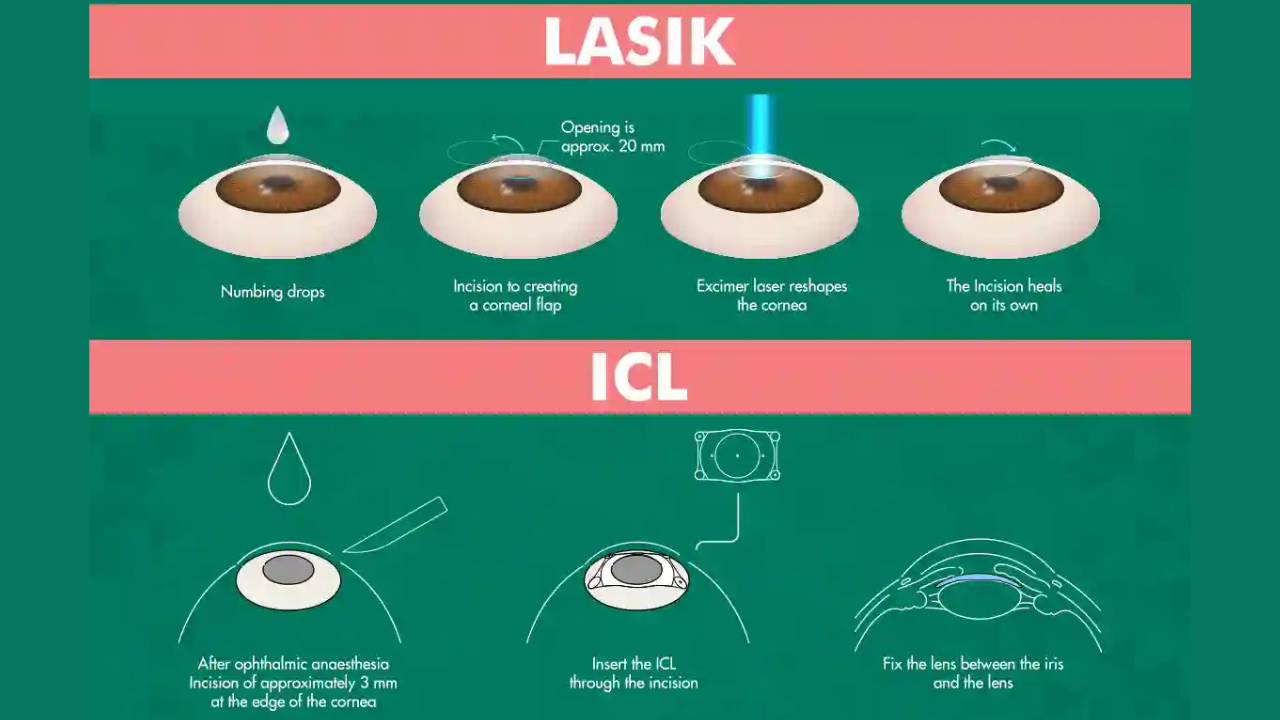
Nothing too dramatic, honestly. Here’s roughly how it goes:
- Numbing drops go in first, and sometimes a mild sedative too, just to help you relax.
- The surgeon makes a tiny incision near the edge of the cornea. We’re talking a few millimeters, not a big cut.
- The lens itself is folded up small enough to slide through that opening, then it’s carefully unfolded into position.
- No stitches are needed most of the time, and you’re out the same day since it’s done as outpatient surgery.
Some surgeons handle both eyes in one sitting. Others prefer spacing it out by a week or so, just to be cautious. Depends on the doctor, really.
Okay, But Is It Actually Safe?
Reasonably, yes. It’s not brand new either; the FDA approved this type of lens back in 2005, so there’s been plenty of time to study long-term results. That said, surgery is surgery, and there are risks. Some people report glare or halos around lights afterward. In rarer cases, eye pressure can go up, or an infection can happen. This is exactly why doctors want you back for checkups after the procedure instead of just sending you off.
ICL or LASIK, Which One Wins?
Honestly, neither one universally “wins.” It depends on your eyes.
ICL works well if your cornea is thin, if you have a high prescription, or if you want something that can be reversed later. LASIK, on the other hand, tends to have quicker recovery and works fine for people with mild to moderate vision issues and healthy corneas.
If your eyes qualify for both, your surgeon will usually walk you through the tradeoffs based on your specific prescription and eye shape rather than picking one as “the best” outright.
Wait, Does ICL Mean Anything Else?
Yeah, actually. If you didn’t land here from an eye surgery search, here’s what else ICL could mean depending on where you saw it:
In cricket, ICL sometimes refers to the Indian Cricket League, an older breakaway league from years back.
In finance, especially in some regional contexts, ICL can stand for Instant Cash Loan.
In tech or coding circles, it occasionally pops up as a shorthand inside specific tools or systems, though this use is far less common.
If none of these fit what you were originally looking for, it’s worth going back and checking the exact page or context where you spotted the term.
Final Word
ICL, in the context most people are searching for, means Implantable Collamer Lens. A small lens is placed inside your eye to fix your vision without reshaping your cornea. It’s not for everybody, but for people who don’t qualify for LASIK, it’s often a solid, safe, and even reversible alternative. If you’re actually thinking about getting it, skip the guessing and just book an eye exam. Only a proper checkup can tell you if your eyes are a good fit.
Read More: CMA Full Form: Meaning, Eligibility, Course, Salary & Career Guide
