

You’re not alone if you’ve heard the term ‘SOP’ and asked yourself what it is! In two cases, the SOP full form is different, depending on where it is used. It’s the acronym used in business for Standard Operating Procedure. In the education field, it means Statement of Purpose.
These two documents are equally vital, but for different purposes. This article covers both these definitions in simple terms, their types, how to write one and its key components.
What Is the Meaning of Full Form of SOP?
There are two common usages of the word SOP and it depends on the context.
- Standard Operating Procedure: A written document used by businesses and organizations. It documents the methodology and procedures a staff member needs to perform a task in the proper manner and in a consistent way. SOPs are used by factories, hospitals, offices and even restaurants to ensure that the work is performed in the same manner by anyone doing it.
- Statement of Purpose: This is a personal essay that students write when applying to a college, university, or professional course. It tells who the applicant is, what he or she has been accomplishing up to this point, and why he/she wants to participate in a specific program. It allows admission committees to get to know a candidate beyond marks and test scores.
Therefore, if someone asks what is the full form of SOP, one should ask them if they are talking about the business document or the college application essay as they are completely different.
Types of SOP
There are two types associated with SOP because it has two meanings.
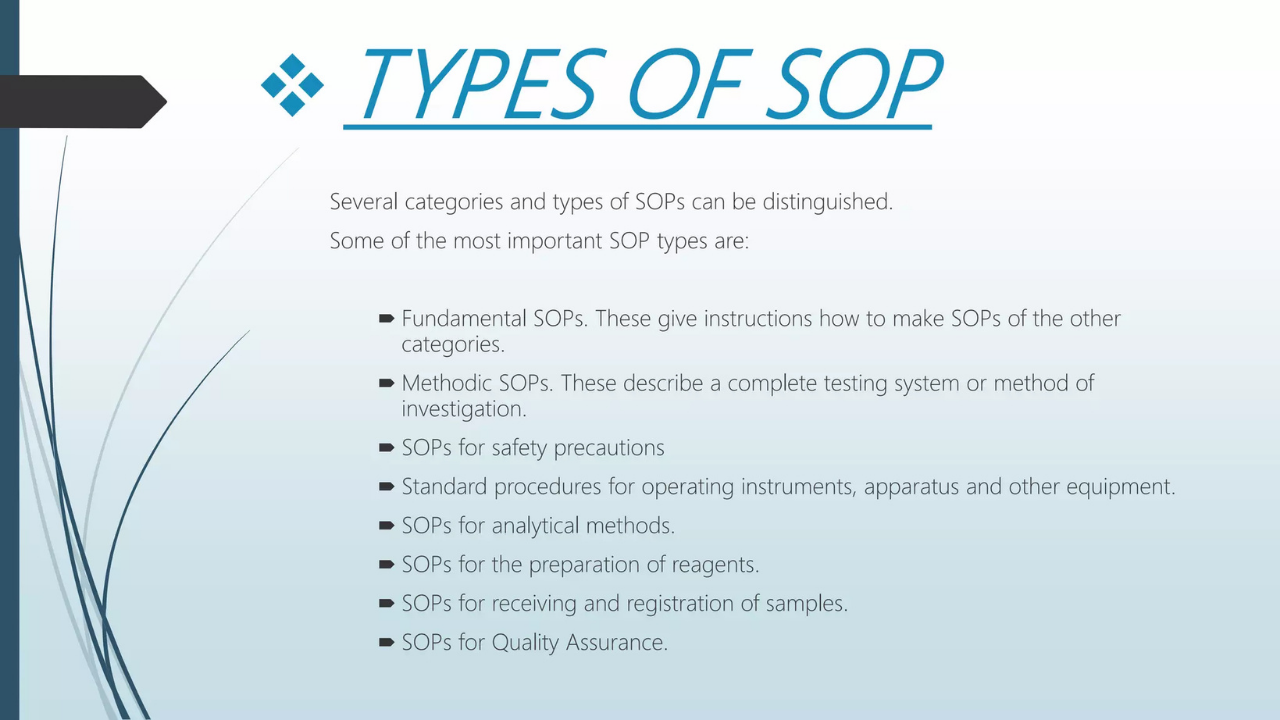
Types of Standard Operating Procedure
- Step by step format: Instructions are numbered in a step-by-step format. This is great for simple jobs.
- Hierarchical format: For longer or more detailed processes. Main steps are broken down into smaller sub-steps.
- Flowchart format: A diagram and arrows are used to illustrate decision points. This is useful when there are several possible results of a process.
- Tick off list: A simple list in which employees can check off each task that they complete.
Common in Quality Checks and Safety Procedures
- Admission SOP: Written for college admissions for Undergraduate or Postgraduate level.
- MBA or professional SOP: Emphasizes employment experiences, leadership qualities and career objectives.
- Research SOP: For PhD or research oriented courses, based on interests in research and previous academic experiences.
- Visa SOP: This is sometimes needed by embassies to verify the genuine purpose of studying abroad.
All have basically the same concept, but are modified to suit the reader and purpose.
Read Also: BUMS Full Form: What It Actually Means (And Why So Many Students Choose It)
How to Write an SOP
The steps to writing a good SOP (business procedure or statement of purpose) are similar.
- Step 1: Purpose and Audience: Before you write anything, determine the purpose and audience. Employees read a business SOP for clear instructions. An admissions committee reads a Statement of Purpose for its authenticity and suitability.
- Step 2: Make an outline Write down the main points to cover before you begin your complete draft. This helps to keep the document well-structured and helps to avoid missing important information.
- Step 3: Use clear and simple language and avoid long, complicated sentences. Read in short paragraphs and simple vocabulary. For a Standard Operating Procedure, this means directions. In the case of a Statement of Purpose, it’s about the honest and specific writing, not the generic phrases.
- Step 4: Read and edit Check for things that do not add value to the draft and delete them. Make sure steps/ideas make sense.
- Step 5: Proofread and format Fix grammar and spelling errors. Include headings, bullets or numbers where necessary to make it easy to scan and follow.
Whether it’s documenting a task at work or preparing a college application essay, these steps will make the SOP full form process that much easier.
Key Elements of an SOP
Also the components vary according to the nature of the SOP that you are writing.
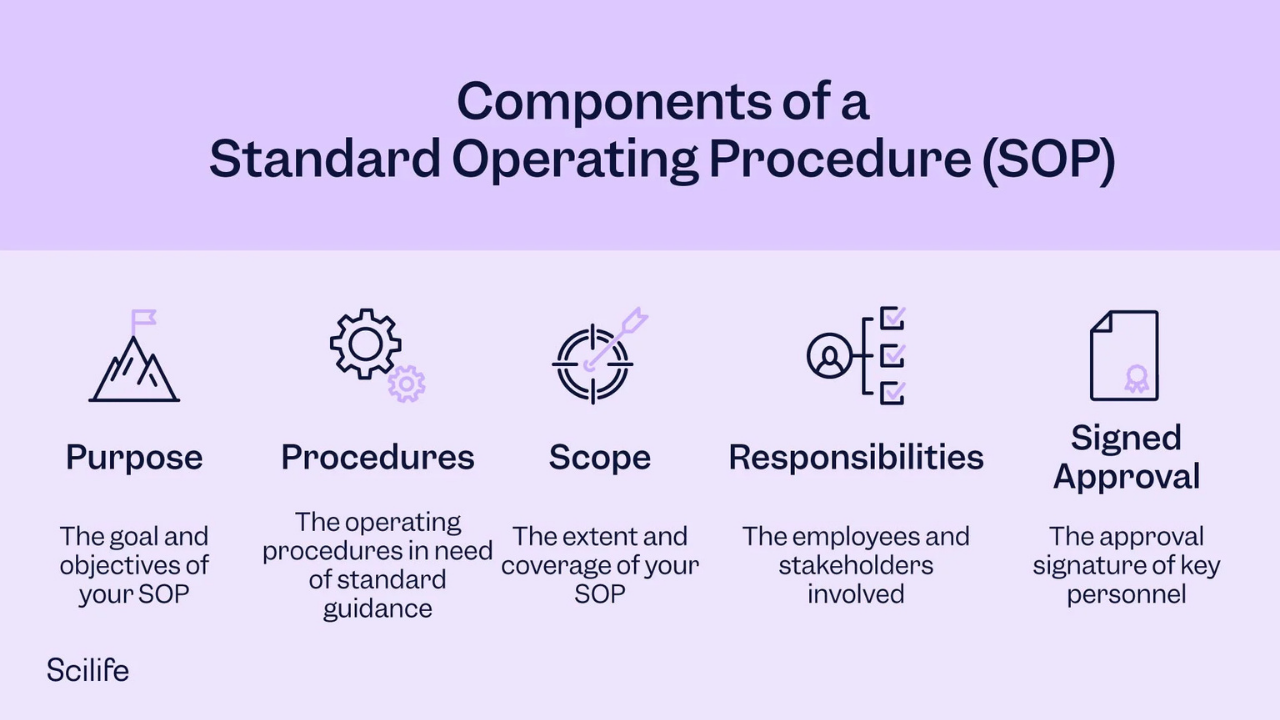
Components of a Standard Operating Procedure
- Title: A process name that is clearly defined.
- Purpose: What the SOP is about and what it is trying to do.
- Intended Audience: Whom the SOP is intended for, when it is applicable.
- Who does what: Who is involved in each step.
- Steps in procedure: The detailed instructions, step-by-step, in writing.
- Safety or Quality notes: Notes that take into account safety or quality that needs to be adhered to.
- Revision history: History of changes made to the SOP and why.
A Statement of Purpose Includes Several Elements
- Introduction: A very brief introduction, which is interesting and can include something about you.
- Academic background: Education and other relevant accomplishments.
- Career objectives: Short and long-term career aspirations.
- Explain the reasons: Why this specific college or course is suitable for your objectives.
- Conclusion: Brief summary that brings the essay together and concludes it with a strong impact.
Why Is an SOP Important?
The repetition of work is maintained by a SOP. It minimizes errors, saves training time for new workers and guarantees quality is not influenced by who is performing the job. In sectors such as healthcare, manufacturing, and food service, where mistakes can have significant consequences, this is particularly crucial.
A Statement of Purpose, on the other hand, is a crucial part of the admissions process. There is more to it than grades and test scores. A well drafted SOP gives the admissions committee a glimpse of your personality, motivation and long term goals. At the competitive level, a compelling SOP can make all the difference between two equally strong candidates.
Common Mistakes to Avoid While Writing an SOP
- Too generally: Both types of SOP should be specific. Employees are baffled by unclear directions, and an application is unmemorable if it gives vague directions.
- Not having a structure: Ideas presented in an out-of-order manner making it difficult to follow the document.
- Copying content off the Internet: An SOP that is just a copy of a template doesn’t sound authentic. Admission officers can tell, pretty easily.
- Not following formatting: Long blocks of text without headings and/or bullet points are hard to read, whether you’re creating a document for the workplace or an application essay.
- Not proofreading: Spelling and grammar errors detract from the professionalism of any SOP.
Final Word
The SOP full form can be either a Standard Operating Procedure or a Statement of Purpose, and it’s not the same thing. One helps companies to maintain consistency and efficiency, the other helps students to clearly present themselves to admission committees. Knowing what makes an SOP, adhering to a writing process, and adding the correct elements, you can produce an SOP that will get the job done, be it for the workplace or for college applications.
FAQs
1.Which is the full form of SOP?
SOP is an acronym for either “Standard Operating Procedure” – for business to document normal procedure, or “Statement of Purpose” – in writing for a purpose.
2.How many SOP’s do you know?
Standard Operating Procedures may take a step-by-step, hierarchical, flowchart or checklist format.
3. What are the major elements of an SOP?
A business SOP consists of the following elements: Title, Purpose, Scope, Roles, and Steps.
4. How do I write an effective SOP?
Know your readers, develop a clear structure, use simple language, be free of jargon or from using generic content, and proofread carefully before completing.
5. Why is an SOP important?
Work is consistent and there is less chance of error with a Standard Operating Procedure.
Read More: BBA Full Form in English: Explore A Complete Guide to BBA Simply
